GesMexa Free consultation
Residency & immigration

Live in Mexico legally, without fighting the INM alone

Temporary residency, the 30-day exchange, CURP, RFC, banking and tax residency for remote workers, retirees and families relocating to Mexico. We build the file, book the appointments and walk you through to the card in your hand.

Handled in English · Every state in Mexico · Answers within 24 hours

180
Max days on a tourist permit
30
Calendar days for the INM exchange
1+3
Years of temporary residency
4
Years before permanent residency

The truth about the "digital nomad visa"

It does not exist. Mexican migration law has no category by that name, however many travel blogs repeat it. What does exist, and works well, is temporary residency by economic solvency under article 52 of the Migration Law.

The legal key is this: you prove you can support yourself without performing paid activities from a Mexican source. A client in Chicago paying you by wire while you live in Mérida is not a Mexican source. That is precisely what the scheme allows, and it is why thousands of remote workers live here under it.

American digital nomad working remotely from a colonial-era cafe in Mexico under a temporary resident card
Remote income from foreign clients is not Mexican-source income. That is the legal basis of the whole route.

The four real routes

Choosing the wrong one at the start costs months and money. Here is what actually exists — and if you are coming to retire, our retirement guide covers the tax and healthcare side too:

Economic solvency

The route for remote workers, freelancers and retirees. You prove foreign income or savings and live in Mexico without depending on the Mexican job market.

  • Starts at a consulate abroad
  • 1 year, renewable up to 4
  • Unlimited entries and exits

Job offer

When a Mexican company hires you. The employer starts the process with INM and you collect the visa at the consulate.

  • Employer needs an INM registration
  • Authorises work in Mexico
  • Tied to that employer

Family ties

Spouse, partner, children or parents of a Mexican national or a resident. The most direct route, and in several cases it can be done from inside Mexico.

  • Spouse of a Mexican: 2-year card
  • Child of a Mexican: often permanent
  • Relationship must be documented

Permanent residency

After four years of temporary status, through direct family ties, through retirement or on points. No expiry and no separate work permit needed.

  • No card renewals
  • Work permitted without extra permit
  • Step before naturalisation

Tourist or resident: the decision most people postpone

Visitor (tourist)Temporary resident
Length of stayUp to 180 days, and the officer at the airport decides the number1 year, renewable up to 4
Where it's obtainedAt the port of entryMexican consulate abroad, then exchanged at INM
CURP and RFCVery limitedYes, with the resident card
Bank accountUsually refusedYes
Entries and exitsRepeated re-entries raise flags and can be refusedUnrestricted
Path to permanentNoneYes, after 4 years
The 180-day trap. Many people enter as tourists assuming they will change status from inside the country later. Except in narrow cases, you cannot: you have to leave Mexico, apply at a consulate and come back. If you also let your entry permit expire, you first have to regularise and pay a fine. The shortcut ends up costing three times as much.

Everything we handle

Before you travel

  • Choosing the correct immigration category
  • Calculating the solvency you will be asked for
  • Reviewing bank statements and translations
  • Consular appointment and interview preparation

Once you land

  • INM exchange within the 30-day window
  • Temporary Resident Card
  • CURP and RFC
  • Renewals and change of status
  • Notices of address or marital status changes

Normal life

  • Opening a Mexican bank account
  • SAT registration and the right tax regime
  • Leases and utilities in your name
  • Company formation if you will invoice in Mexico

Immigration residency is not tax residency

This is the part almost no immigration facilitator explains, and it is where we are different: we are a tax firm first, not a visa shop.

Holding a resident card does not automatically make you a Mexican tax resident. That is decided under article 9 of the Federal Tax Code, mainly by where your home and your centre of vital interests are. You can live here on temporary residency and still be taxed elsewhere, or drift into Mexican tax residency without noticing and end up with SAT obligations nobody warned you about.

If you are American, your IRS obligations do not disappear when you move — the U.S. taxes citizens on worldwide income. What the Mexico–U.S. treaty does is stop the same income being taxed twice. We handle the Mexican side and coordinate with your U.S. preparer.

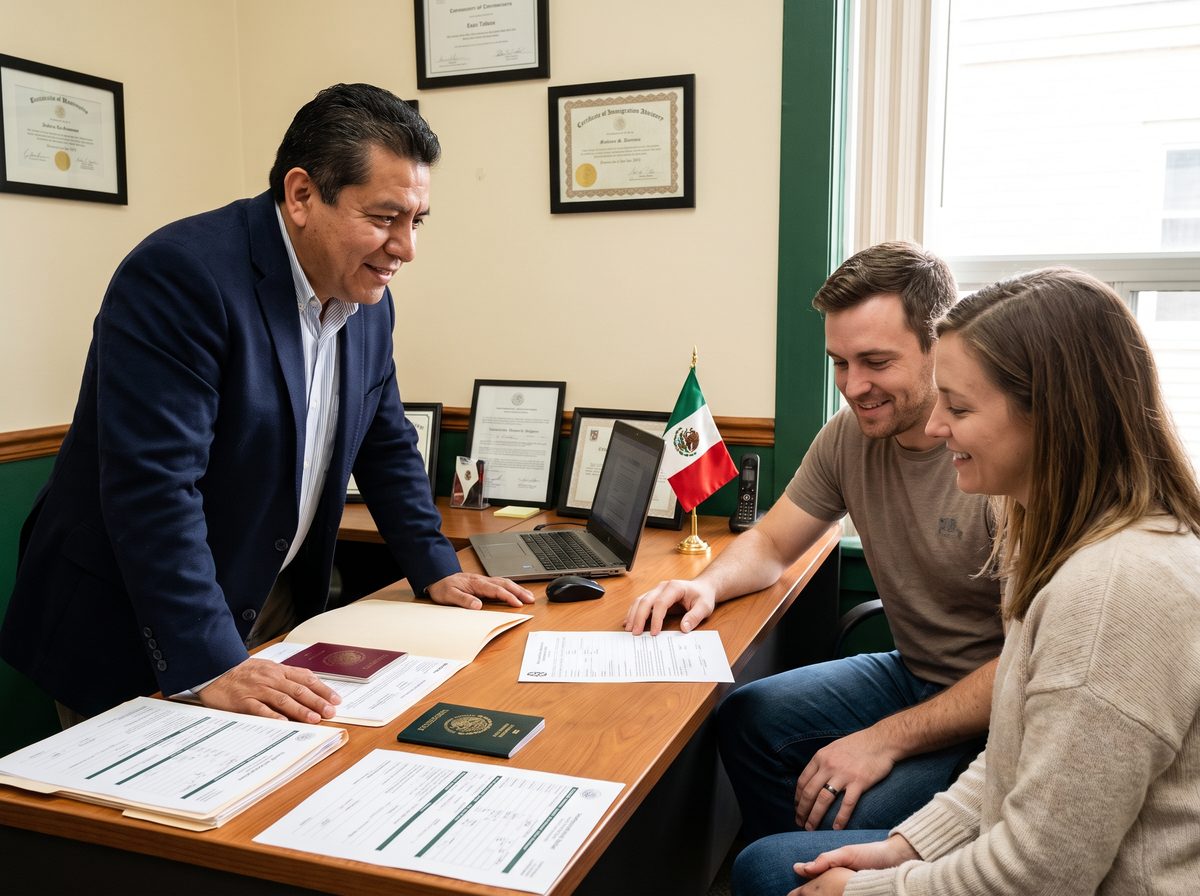
GesMexa advisor reviewing a foreign couple's Mexican residency file before their INM appointment
We build the consular file and handle the INM exchange. You just show up to the appointment.

How we work

Assessment

You tell us your situation and we tell you which route applies, what will be asked of you and the real timeline. No cost.

The file

We assemble the documentation, check translations and thresholds, and book the appointment at the consulate with jurisdiction over you.

INM exchange

Once you arrive we file the exchange within the 30-day window and go with you to the appointment until your card is issued.

Settled in

CURP, RFC, bank, tax regime and renewals. We stay with you through the four years.

Residency questions

Is there a digital nomad visa in Mexico?+

No, not under that name. Mexican immigration law has no such category. What digital nomads actually use is temporary residency under the economic solvency route, set out in article 52 of the Migration Law. It works because you prove you can support yourself without performing paid work from a Mexican source — and a client in Chicago paying you by transfer while you live in Mérida is not a Mexican source.

Can I switch from tourist to resident while I'm already in Mexico?+

With very narrow exceptions, no. The economic solvency application starts at a Mexican consulate abroad. This is the single most expensive mistake we see: people burn their 180 tourist days, then discover they have to leave the country and start over. If your entry permit has already expired, there may also be a fine for irregular status before you are allowed to leave.

How much money do I need to show?+

There is no single national figure. The amount is calculated on the UMA, a government reference unit, and each consulate publishes its own threshold and its own rules on bank statements. You can usually qualify either through around six months of monthly income or twelve months of average balance, and the requirement increases for each dependent. We check the exact consulate that has jurisdiction over you before you book anything.

What is the INM exchange and why does it matter so much?+

The visa stamped in your passport at the consulate only lets you enter. Once in Mexico you have 30 calendar days to go to the INM, the immigration institute, and exchange it for your actual Temporary Resident Card. Miss that window and the whole process collapses and has to be restarted from the consulate.

How long does residency last?+

The first card is issued for one year and can then be renewed for one, two or three more, up to four years total. After four years as a temporary resident you can apply for permanent residency without proving solvency again.

Does residency make me a Mexican tax resident?+

Not automatically. They are separate questions. Tax residency is determined by article 9 of the Federal Tax Code, primarily by where your home and your centre of vital interests are located. You can hold a residency card and not be a tax resident, or become one without holding a card. Getting this wrong is what produces surprise SAT assessments years later.

Do I need an RFC if all my income comes from abroad?+

Strictly speaking it depends, but in practice you will want one. Without an RFC you cannot invoice, you will struggle to open certain bank accounts, and you cannot put utilities or leases properly in your name. If you do become a tax resident, it stops being optional.

Can you help my spouse and children too?+

Yes. Dependents can be included in the same process, with additional income or balance required for each one. We handle family files regularly, including cases where one spouse qualifies through economic solvency and the others follow through family unit.

What if the INM says no? A refusal is not the end of the road. Decisions by the National Immigration Institute are acts of authority and a federal judge can review them through an immigration amparo, flat fee MX$12,900. Where deportation or detention is involved, an amparo can be filed at any time and the removal can be suspended outright.

Tell us where you are and what you're planning.

We will tell you which route applies, what you have to prove and how long it really takes. Free, in English, within 24 hours.

Message us on WhatsApp